

The Basilica Cistern Medusa head column bases are the single most photographed detail inside the cistern, and most first-time visitors nearly walk past them. Before you book a Hagia Sophia and cistern ticket, here’s exactly where to find both heads, the forest of columns around them, and what to do if the cistern happens to be closed the day you planned to go.
 Ready to see prices? Hagia Sophia Skip-the-Line Ticket, from $37.93 See times
Where Are the Medusa Heads in the Basilica Cistern?
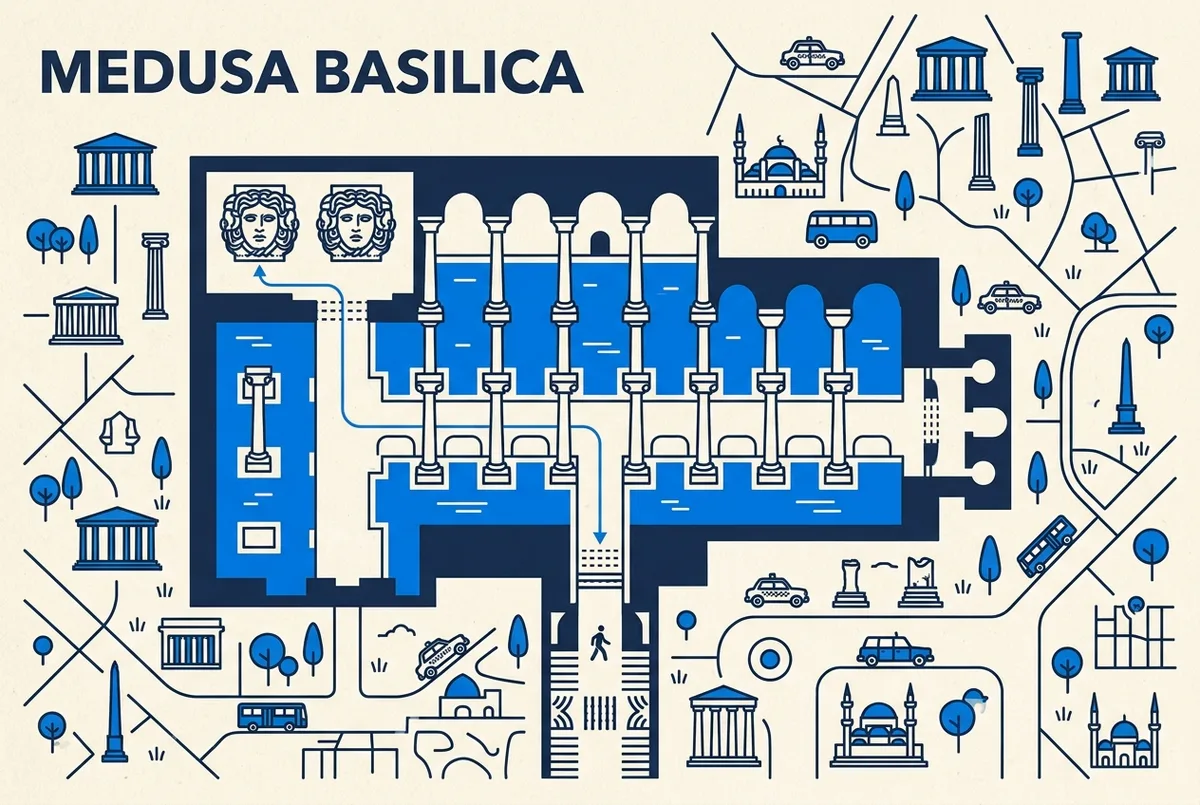
Both carved Medusa heads sit in the cistern’s northwest corner, used as the base of two columns rather than displayed as standalone pieces, which is why first-time visitors often walk right past before spotting them.
Wikipedia places both heads in the northwest corner, each forming the base of a column rather than sitting on a pedestal of its own. Time Out Istanbul describes them as two column bases of unknown origin, each carved with an upside-down Medusa head, tucked among the hundreds of other columns rather than set apart. If you’re looking for the Basilica Cistern Medusa head on your visit, head toward the far corner from the entrance walkway; it’s not near the start of the route.
Why Are the Basilica Cistern’s Medusa Heads Upside Down and Sideways?
Nobody actually knows: the blocks were reused from an older structure, and there’s no documented evidence they were ever meant to be column bases in the first place, which makes every “warding off evil” or “dominance over paganism” story a guess rather than a fact.
Wikipedia is direct about this uncertainty: the origin of the two heads is unknown, and there is no evidence they were originally used as column bases anywhere else. That’s worth knowing before you repeat one of the popular theories as settled history. I’d tell visitors to enjoy the mystery rather than pick a favorite legend and present it as fact, since the honest answer is that historians genuinely don’t know.
Want a closer look? Hagia Sophia Skip-the-Line Ticket, from $37.93 See timesHow Many Columns Does the Basilica Cistern Have?
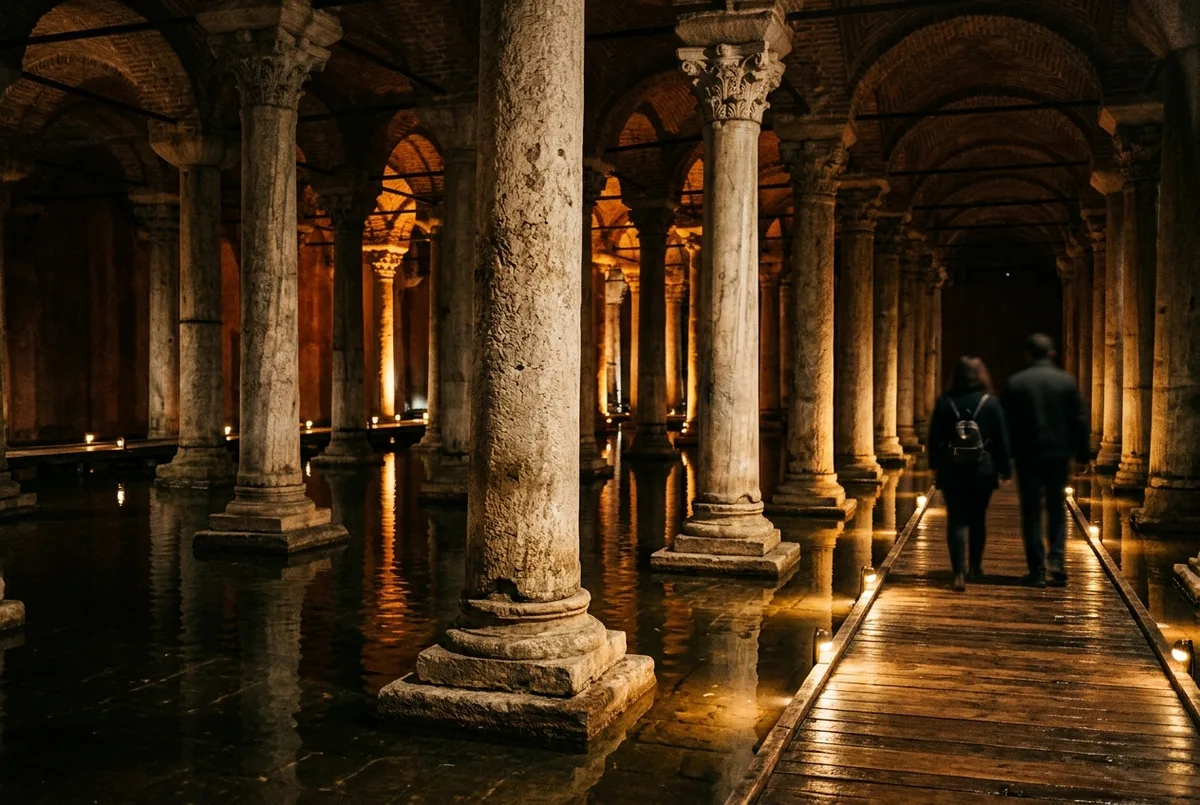
Around 336 marble columns, roughly 9 meters tall, arranged in 12 rows of 28; many were reused from older buildings elsewhere in the empire rather than carved specifically for the cistern.
Wikipedia and Time Out Istanbul both put the count at 336, while History Hit also cites 336 engraved marble columns, noting many appear to have been reused from older buildings elsewhere in the empire. That agreement across three independent sources is unusual for a site this old, where figures often drift; you can treat 336 as the reliable number rather than the “336 versus 338” split some older pages repeat without citing a source.
| Fact | Figure |
|---|---|
| Build date | 6th century AD, under Justinian I |
| Dimensions | About 138 m by 65 m |
| Water capacity | Up to 80,000 cubic meters |
| Column count | About 336 |
| Column height | About 9 meters |
What Else Is There to See Inside the Basilica Cistern Besides the Medusa Heads?
Beyond the columns and the Medusa heads, expect vaulted brick ceilings, carp swimming in the shallow water, and the sheer scale of a reservoir built to hold up to 80,000 cubic meters of water for the Byzantine palace.
History Hit describes visitors walking raised platforms past vaulted ceilings, dripping water and fish, with historical artefacts on display and art exhibitions held regularly inside the space. Wikipedia’s dimensions, 138 by 65 meters holding up to 80,000 cubic meters, give a sense of just how much room the columns are holding up. Picture working your way to the far northwest corner against a thin stream of other visitors, all angling for the same low shot of the upside-down head. Waiting even 30 seconds for the crowd to thin usually gets you the clean photo everyone else is fighting for.
If the scale and the Medusa heads have you sold, our honest verdict on whether the Basilica Cistern is worth it weighs it against Hagia Sophia and Topkapi Palace, and what is the Basilica Cistern covers the full history behind it.
Ready to see prices? Hagia Sophia & Blue Mosque Tour with Ticket, Optional Cistern, from $16.50 See timesBasilica Cistern Medusa Head: FAQ
Were the Medusa heads always part of the Basilica Cistern?
No. The carved blocks were reused from an older, unidentified structure rather than made specifically for the cistern, and there’s no evidence they were originally meant as column bases at all.
How old is the Basilica Cistern?
It dates to the 6th century AD, built under Byzantine emperor Justinian I, making it roughly 1,500 years old.
Can you touch the water inside the cistern?
Visitors stay on raised wooden walkways above the shallow water rather than walking through it, so you view the columns and water from just above the surface without touching it directly.
What happens if the Basilica Cistern is closed on the day you planned to visit?
Operators typically substitute the nearby Şerefiye Cistern or the Cistern of Theodosius as an alternative when the main cistern is shut; check your booking confirmation for details on the day rather than assuming your visit is cancelled outright.
I’d set aside a little extra time at the northwest corner specifically for the Medusa heads rather than rushing the whole walkway in one pass; it’s the one spot in the cistern worth lingering at. For ticket prices and formats, see the Basilica Cistern tickets guide, and for a verdict on whether the whole stop earns its place in your day, is the Basilica Cistern worth it has the full answer. If a live guide pointing out details like these appeals more than exploring alone, the guided tour comparison covers that choice, and anyone considering a quieter visit after dark can check our Night Shift tickets guide.
Want a closer look? Hagia Sophia Skip-the-Line Ticket, from $37.93 See times