

What is the Basilica Cistern? It’s a vast 6th-century underground water reservoir in Istanbul’s old city, now open to the public as a museum, and it sits close enough to pair naturally with a Hagia Sophia ticket on the same trip. Here’s its history, size and the two carved heads most visitors come specifically to photograph.
 Ready to see prices? Hagia Sophia Skip-the-Line Ticket, from $37.93 See times
What is the Basilica Cistern?
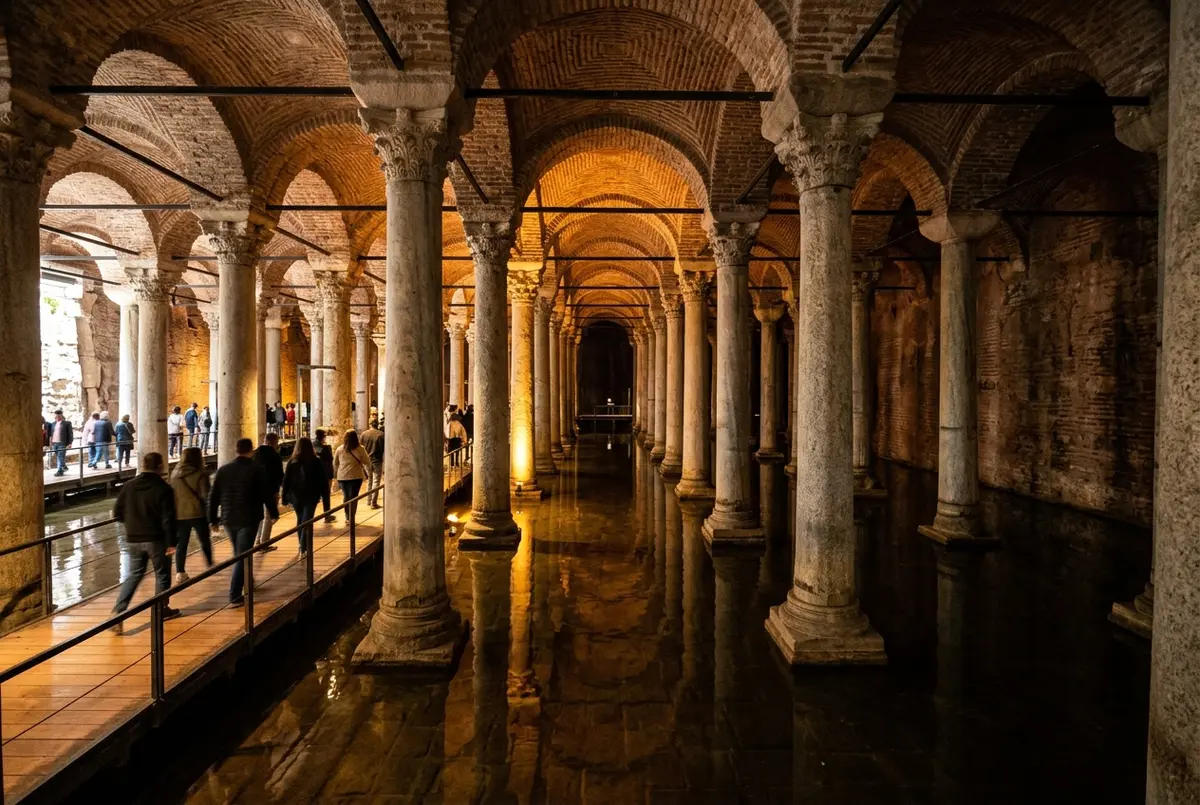
The Basilica Cistern is a vast underground water reservoir in Istanbul’s old city, built in the 6th century and now open as a museum. It sits a short walk from Hagia Sophia and is best known for its forest of marble columns and two carved Medusa heads.
The cistern’s own official history page dates it to 532 AD, commissioned by Byzantine emperor Justinian I to store water for the Great Palace of Constantinople, especially during sieges. Wikipedia’s entry adds the scale: roughly 9,800 square meters in area with a capacity of about 80,000 cubic meters of water, all held up by 336 reused marble columns.
| Fact | Figure |
|---|---|
| Built | 532 AD |
| Dimensions | 138m x 65m |
| Water capacity | 80,000 m³ |
| Columns | 336 |
| Column height | 9m |
| UNESCO listing year | 1985 |
Why is it called the Basilica Cistern?
It takes its name from the Stoa Basilica, a large public square that once stood above it on Constantinople’s First Hill. Its Turkish name, Yerebatan Sarnici, roughly translates to “sunken cistern” and describes the same underground structure.
Go Turkiye’s description of the site confirms the cistern was built on the site of a former basilica, which is exactly where the English name comes from. The Turkish name isn’t a second, unrelated label; it’s a direct description of what the structure physically is, as Wikipedia’s article on the cistern lays out alongside the Greek-derived “basilica” naming.
Want a closer look? Hagia Sophia Skip-the-Line Ticket, from $37.93 See timesHow old is the Basilica Cistern?
The cistern dates to 532 AD, commissioned by the Byzantine emperor Justinian I to store water for the Great Palace of Constantinople, especially during sieges. That makes it roughly 1,500 years old.
The official history page and Wikipedia agree on the 6th-century, Justinian-era construction date. The cistern fell out of everyday use after the 1453 Ottoman conquest, then sat largely forgotten until restoration work reopened it to the public in 1987.
Short on time? Hagia Sophia, Basilica Cistern & Blue Mosque Tickets with Audio, from $93.49 See timesHow big is the Basilica Cistern?
It measures about 138 by 65 meters and once held roughly 80,000 cubic meters of water. Inside, 336 marble columns stand in 12 rows of 28, each about 9 meters tall.
Both the official source and Wikipedia give matching figures for the footprint and column count, which is unusual for a site this old where numbers often drift between sources. Go Turkiye rounds the column count to “more than 300,” consistent with the same 336 figure.
Ready to see prices? Hagia Sophia & Blue Mosque Tour with Ticket, Optional Cistern, from $16.50 See timesWhat are the Medusa heads in the Basilica Cistern?
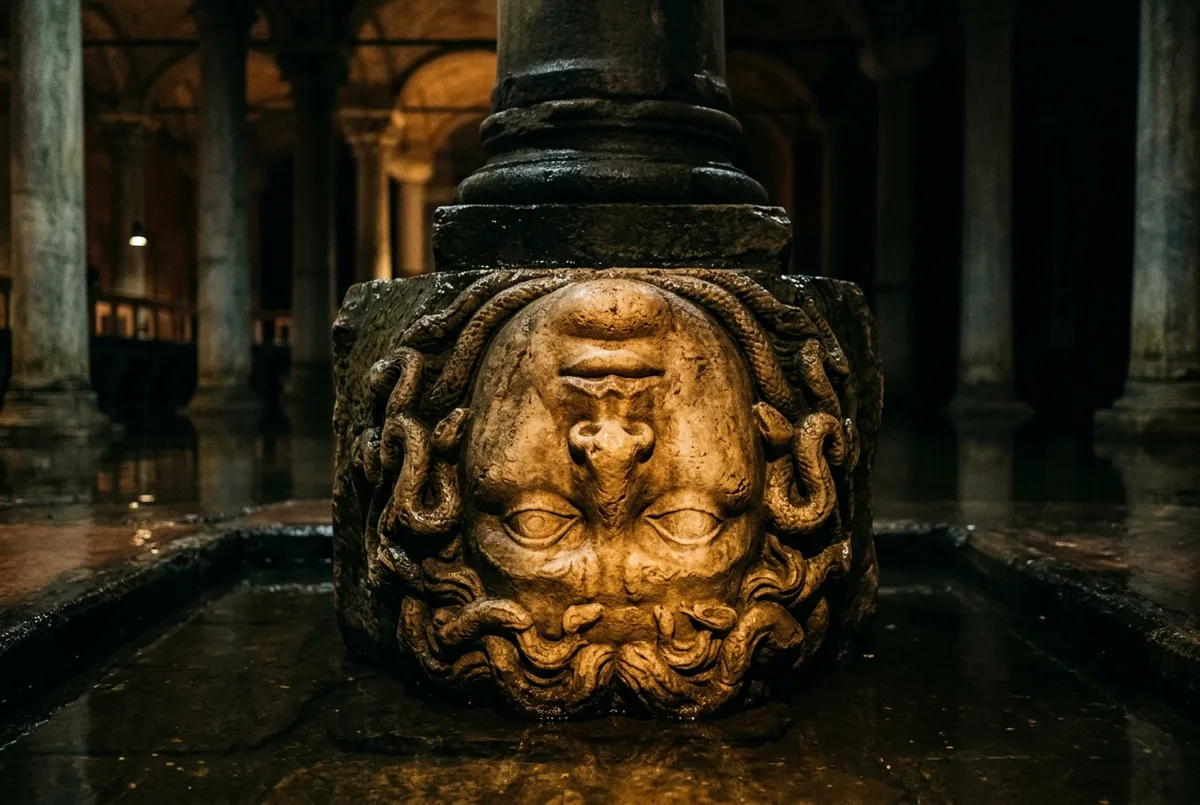
Two carved Medusa heads form the base of columns in the cistern’s northwest corner, one turned sideways and one upside down. Historians aren’t certain where they came from, though they were likely salvaged from an earlier Roman monument.
Wikipedia notes that there’s no evidence the heads were originally made as column bases at all, which makes their current orientation a reuse decision rather than an original design choice. The cistern’s own history page agrees they were likely reused from earlier Roman monuments.
Picture a visitor following the raised wooden walkway toward the cistern’s far corner, phone already out, only to find the upside-down Medusa head lit from below by a single spotlight. They have to crouch at an angle to get both carved faces in one photo, since the sideways head sits several meters further along the same row. For the fuller picture of what else to look for down there, see what to see inside the Basilica Cistern.
Want a closer look? Hagia Sophia Skip-the-Line Ticket, from $37.93 See timesIs the Basilica Cistern part of a UNESCO World Heritage Site?
Yes. It falls inside the Historic Areas of Istanbul, a UNESCO World Heritage Site inscribed in 1985 that covers several landmarks in the old Sultanahmet district, not the cistern alone.
Wikipedia confirms the 1985 listing as part of the broader serial site, which also covers Hagia Sophia and the historic peninsula rather than naming the cistern as its own standalone entry.
Short on time? Hagia Sophia, Basilica Cistern & Blue Mosque Tickets with Audio, from $93.49 See timesIs the Basilica Cistern worth visiting?
Most visitors find it worth the short detour: it’s a genuinely different kind of sight from Hagia Sophia or the Blue Mosque, cool and atmospheric underground, and the visit itself is short. For a full breakdown of what to expect, see our dedicated verdict on whether it’s worth it.
I’d pair it with Hagia Sophia on the same outing rather than making a separate trip for it alone, since the two sites sit minutes apart and our Hagia Sophia and Basilica Cistern combo bundles both. For the full pricing picture across every ticket format, see our Basilica Cistern tickets guide, and if a live guide appeals more than exploring on your own, our guided tour comparison covers that choice. Prefer a quieter, differently lit visit over a daytime crowd? Our Night Shift tickets page covers that evening option.
Ready to see prices? Hagia Sophia & Blue Mosque Tour with Ticket, Optional Cistern, from $16.50 See timesWhat Is the Basilica Cistern: FAQ
Is the Basilica Cistern completely underground?
Yes. The entire structure sits below street level, originally built to store water out of sight beneath the city.
How long does it take to visit the Basilica Cistern?
Most visitors spend 30 to 45 minutes walking the wooden walkways at a comfortable pace, longer if you stop for photos at the Medusa heads.
Can you walk on water at the Basilica Cistern, or just beside it?
You walk on raised wooden walkways built above the shallow water, not directly through it, so you view the columns and water from just above the surface.
Has the Basilica Cistern appeared in any films or books?
Yes. It appeared in the 1963 James Bond film “From Russia with Love,” and its inverted Medusa pillar features in Dan Brown’s 2013 novel “Inferno.”
Want a closer look? Hagia Sophia Skip-the-Line Ticket, from $37.93 See times